How Much Does It Really Cost to License a Movie? (2025 Guide for Creators & Institutions)
📅 Feb 2025⏱ 9 min readLicensing Costs
Movie licensing costs vary depending on rights type, territory, audience size, platform, and duration of use.
When Do You Need Public Performance Rights?
If you're planning to show a movie outside your home—and invite anyone beyond your immediate
family or a few close friends—you likely need what's called Public Performance Rights (PPR).
These rights apply to a wide range of events, venues, and organizations. Let’s break down the
most common scenarios where a movie license is legally required.
Community Events (Libraries, Parks, Fundraisers)
Hosting a movie night in a library, local park, or during a neighborhood fundraiser? Even if
your event is free to attend, it still qualifies as a public performance—and yes, you need a license.
Real Example: The City Library of Santa Clara held an outdoor summer film
series. Despite being a free community event, they legally licensed every movie to avoid
copyright issues and potential fines.
Venue type: Public, nonprofit setting
Audience: Larger, open to the public
License required even if no admission is charged
Pro Tip: Partnering with local schools or businesses can sometimes allow you
to split licensing costs or gain access to a shared annual license for multiple community events.
Schools, Colleges & Universities
Educators often assume that any use of film in class is fair game. That’s partly true—but it
depends on the context. If the screening is strictly for face-to-face teaching and closed to
outsiders, you’re usually covered by an exemption. But for school-wide events or orientation
nights, a license is required.
Fact: According to MPLC, over 90% of campus film screenings fall outside the
“teaching exemption” and must be licensed.
Curriculum-based use? No license (in most cases)
Recreational or extracurricular event? License required
Pro Tip: Some colleges budget for umbrella campus licenses annually—check with
student affairs or the campus legal office first.
Churches and Religious Gatherings
Faith-based organizations often show films to create community or enrich worship. Any public
screening—even in a church setting—requires permission.
Example: A youth group shows a Christian-themed drama at a retreat. Even
nonprofit religious events must obtain licenses unless the film includes explicit ministry permissions.
Pro Tip: Services like CVLI offer annual church video licenses covering many
titles for one flat fee.
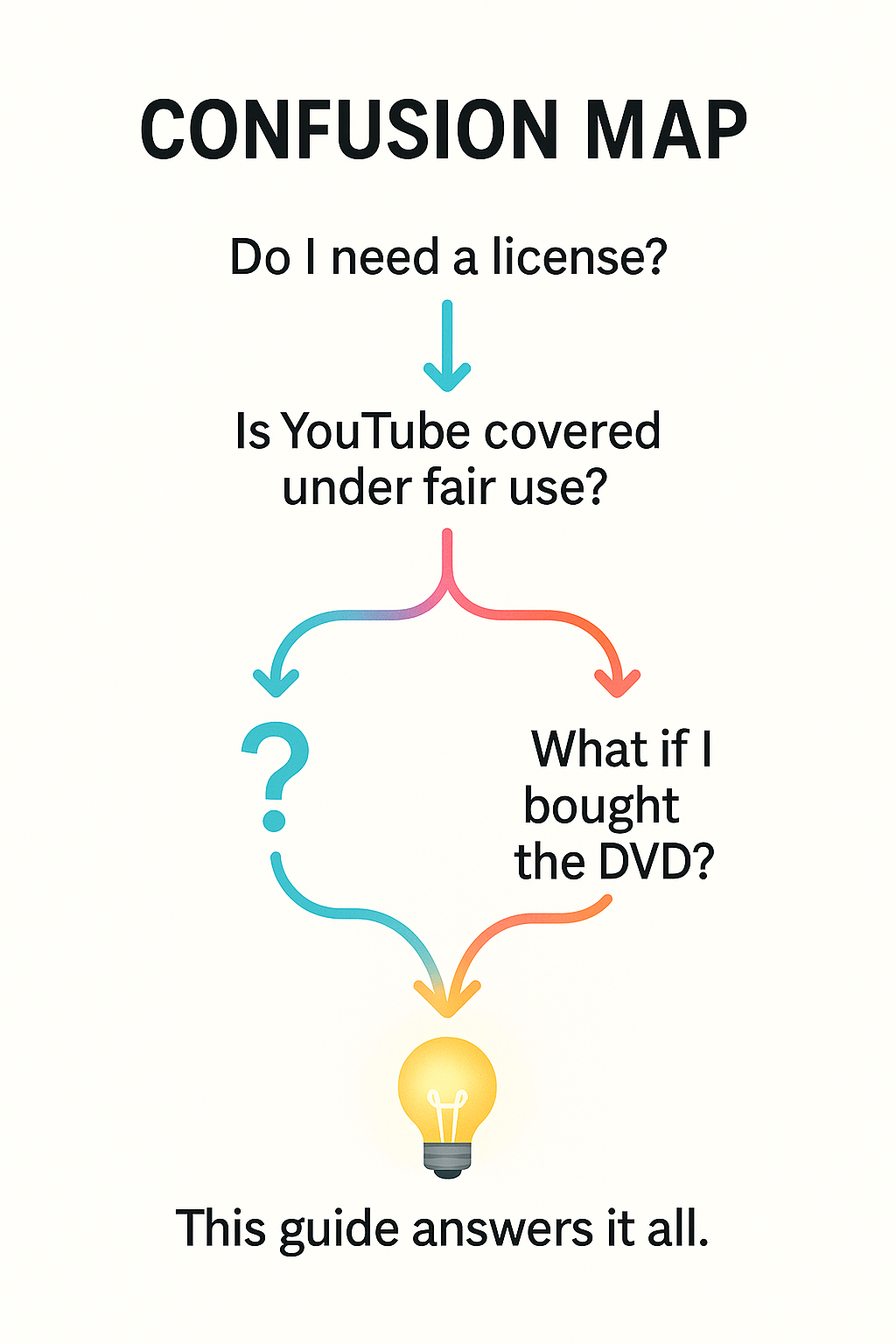
A visual guide to the most common questions creators ask about movie licensing and fair use.
You're Not Alone: Licensing Confusion Is Common
Most creators, educators, and event organizers are confused about movie licensing—how it works, what it costs, and where to start.
Real Example: One afternoon, an indie filmmaker named Rachel reached out to a licensing agency. She had just finished a micro-budget documentary and wanted to include two short film clips—both under 20 seconds. To her surprise, one of the clips required a $1,200 clearance fee, even for minimal use on YouTube. The other wasn’t available for digital licensing at all.
This isn’t rare. The movie rights cost varies drastically depending on how and where you plan to use the content. There’s no public “price list,” and most licensing agencies only provide quotes upon request—leaving most first-timers lost in a maze of legal and financial uncertainty.
You Might Be Wondering:
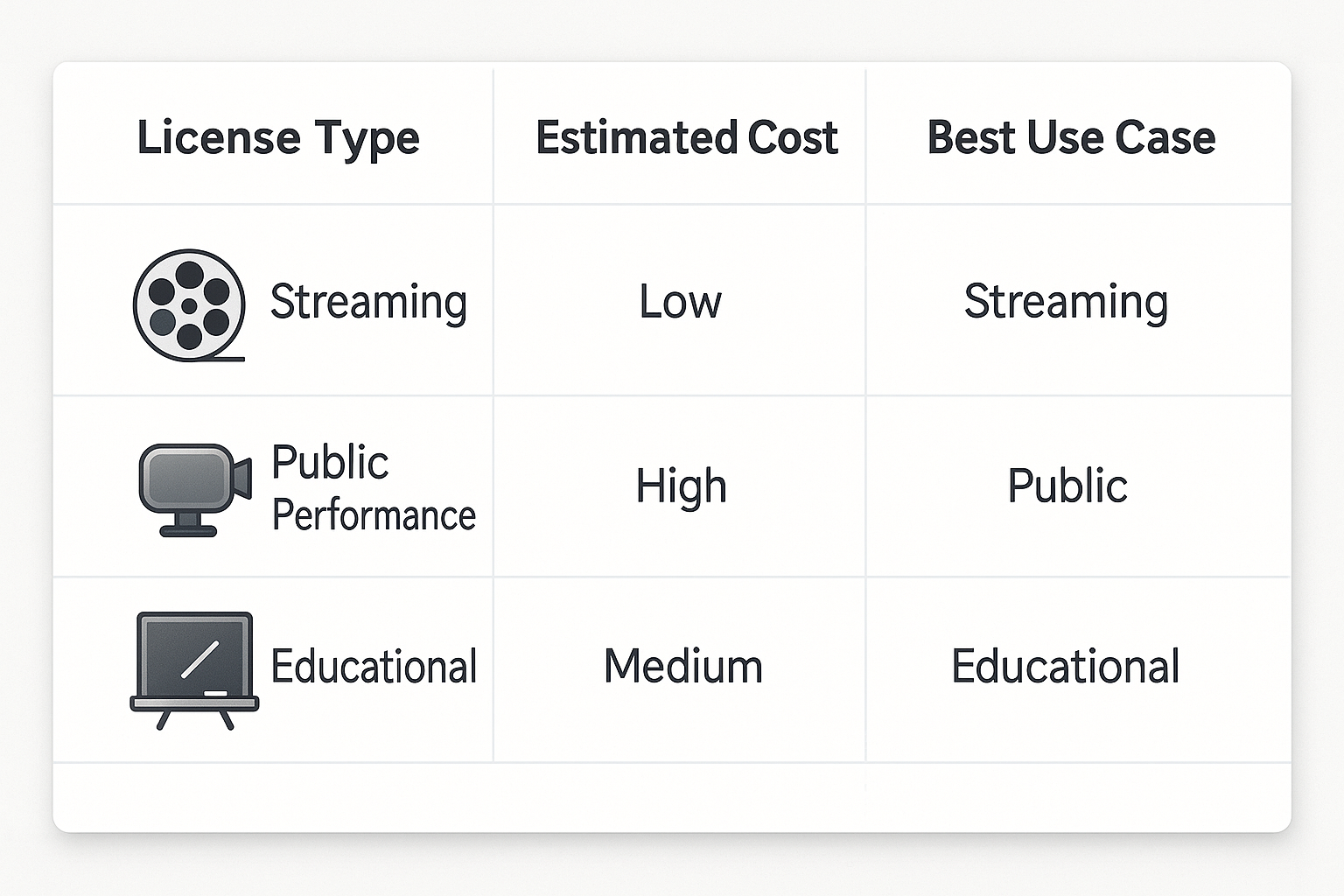
Different types of movie licenses vary in cost and use case depending on how the content will be shown.
Your Quick Guide to Movie Licensing
When it comes to movie licensing, most people face three major questions:
What type of license do I need? How much will movie rights cost? And where do I get it?
This guide answers all three—clearly, simply, and with examples you can act on today.
Whether you're an indie filmmaker clearing clips for a streaming release, or a school planning a family movie night, this guide breaks down every relevant cost, license type, and real-world workaround.
Here’s What You’ll Get:
A full breakdown of movie rights cost by license type (streaming, public screening, educational, etc.)
A comparison of major license providers like Swank and MPLC
Practical tips to avoid overpaying or violating copyright law
Case studies showing how creators and institutions license movies effectively on a budget
Real Example: Take Amanda, for example—she runs a nonprofit community center in Ohio. Her team planned a summer outdoor movie series. Instead of licensing each title individually, they secured an umbrella license through MPLC, covering unlimited showings of hundreds of movies for a flat annual rate. Total cost: $685/year—less than one legal fine would’ve been.
If you're trying to plan a launch, build a content library, or stay compliant in your classroom, you don’t have time to sift through vague legal language or email chains with licensing agents. This guide simplifies the process—and even includes links, pricing tiers, and provider comparison tables.
Pro Tip: When budgeting for a streaming license, always ask whether the fee includes worldwide digital rights or is limited to a specific territory. Many creators get caught with takedown notices because they only cleared U.S. usage.
By the time you're done, you’ll not only know what your licensing options are—you’ll know exactly which one makes the most sense for you.
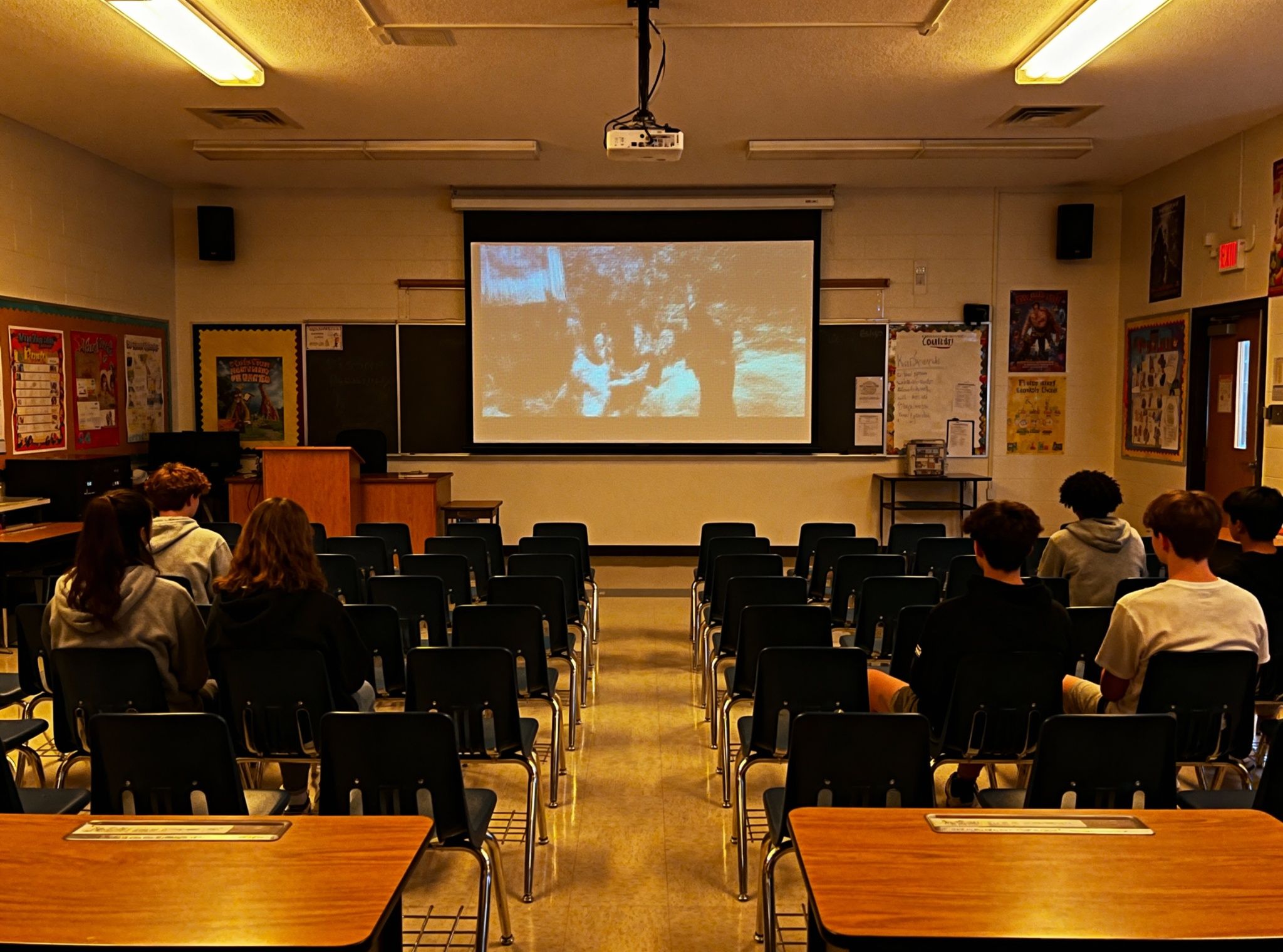
School screenings are legally considered public performances and typically require proper licensing.
How Much Does It Cost to License a Movie?
If you're here, you're probably asking a version of the same question thousands of others Google each month:
How much does it cost to license a movie? movie rights cost.
And more importantly—which license do I actually need?
This guide was built specifically for creators, educators, institutions, and startup platforms who are tired of getting vague answers and surprise quotes. We’ve done the digging for you—so you can plan ahead, stay legal, and avoid costly mistakes.
You’ll Discover:
Exactly which type of license applies to your situation: public performance, streaming, educational, or umbrella.
What typical movie licensing costs look like—ranging from $300 to $2000+, depending on your use case.
How to get quotes from trusted providers like Swank, Criterion, and MPLC.
Real-world stories from creators and organizations just like yours who got it right—and those who didn’t.
Real Example: A middle school in California wanted to stream a Pixar movie during an online “family night” in 2021. Because they assumed their DVD purchase covered the screening, they received a $1,750 violation notice within 30 days. That could have been avoided with a $400 event license.
Pro Tip: When contacting licensing providers, always clarify venue type, audience size, and format (in-person vs digital). These factors can shift your quote by hundreds of dollars—but most websites don’t mention that.
So if the words “licensing,” “fair use,” or “performance rights” leave you overwhelmed—this guide is your clear, actionable, no-fluff answer.
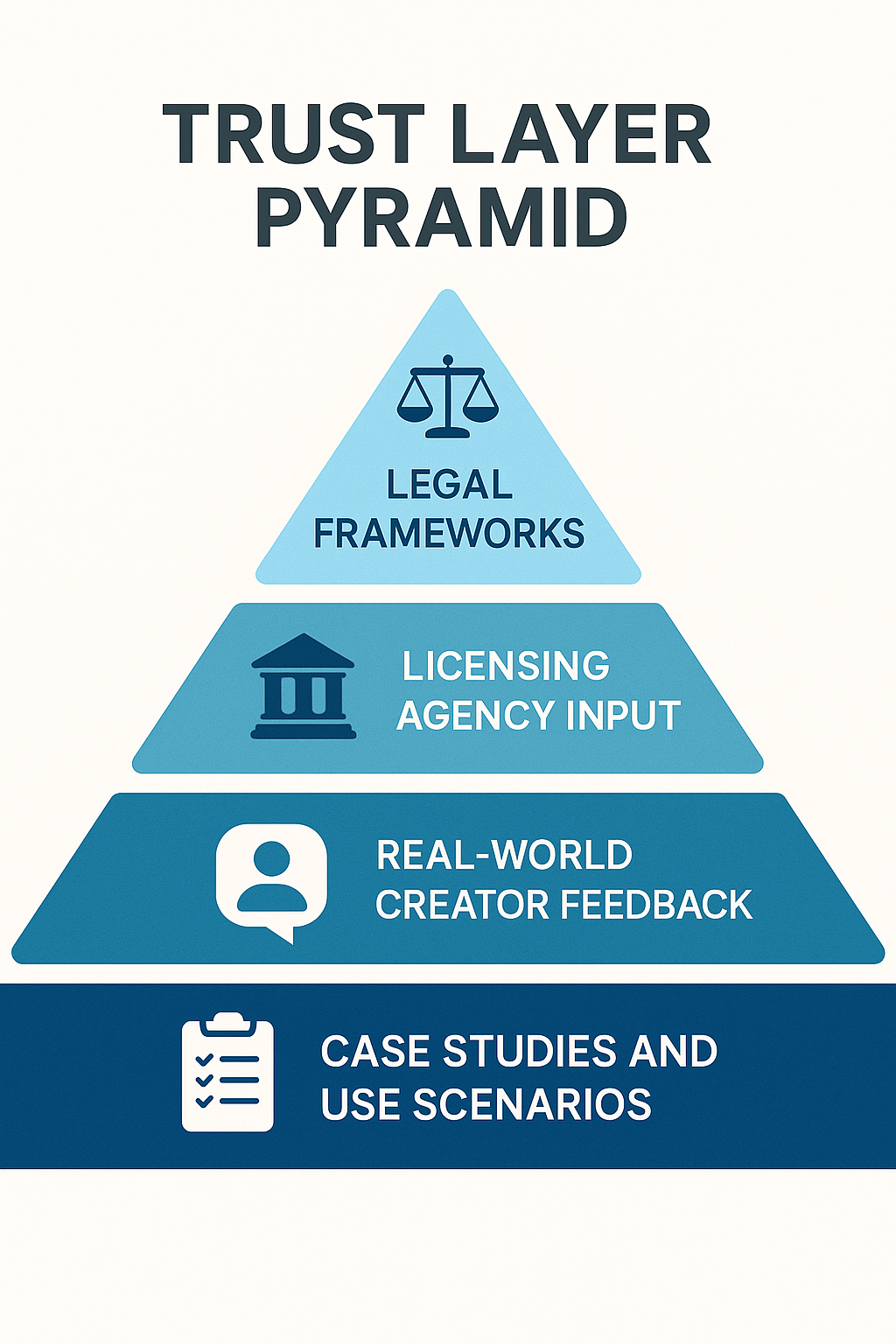
Trusted licensing decisions rely on legal standards, agency guidance, and real-world creator experience.
Movie Rights Cost: What You Really Need to Know
If you're researching movie rights cost, you need more than just price tags—you need clarity, credibility, and real-world insight.
This guide was built with contributions from:
Licensing agents at MPLC and Swank Motion Pictures
Legal analysts familiar with U.S. Copyright Act Section 110
Educators and filmmakers who’ve secured both one-time and long-term rights
Case studies of real screenings, streaming projects, and licensing missteps
Every section of this guide has been reviewed against current licensing frameworks, publicly available pricing models, and expert input from people who’ve actually navigated the process.
Real Example: Jay, a YouTuber producing a series of short documentary interviews, spent six weeks emailing back and forth with a licensing agency for one 18-second movie clip. This guide shows you exactly how to cut that time in half, by listing required details you should include in your first inquiry (audience size, distribution channel, clip length, region).
According to Swank, over 40% of screening license delays are due to incomplete or unclear usage descriptions—something this guide directly solves.
Pro Tip: Most quote delays come from creators forgetting to mention whether their project will be monetized. This factor alone can shift your price bracket significantly—sometimes doubling your quote. Always include it upfront.
So whether you're planning a campus movie night or clearing assets for a docuseries pitch, you’re in expert hands here—with guidance backed by professionals who’ve done it before.
What Does It Mean to License a Movie?
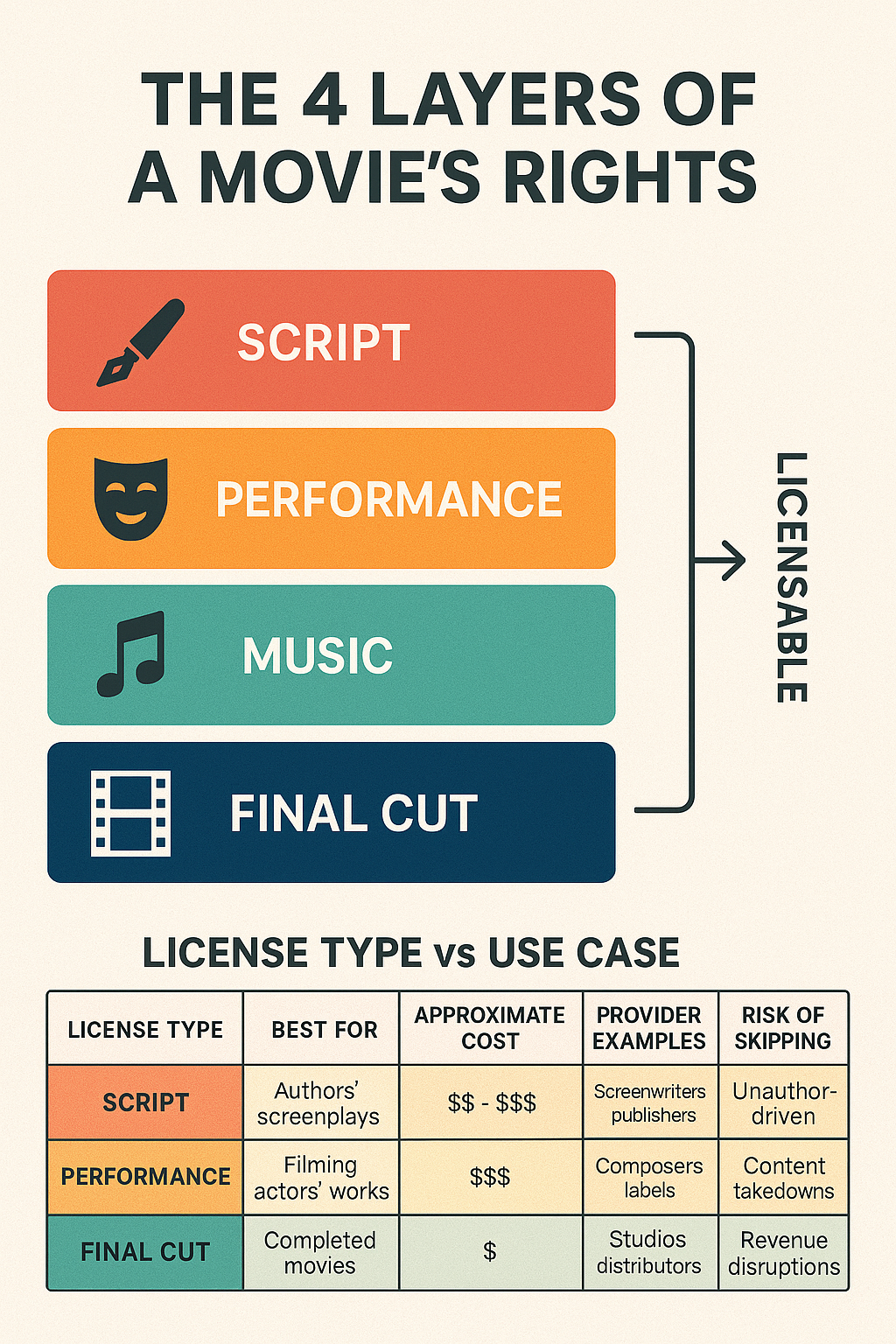
Every film contains multiple rights layers, each requiring separate clearance for legal use.
What Are Movie Rights? (Definition & Terminology)
When you license a movie, you’re not buying the film—you’re buying permission to use it in a specific way, for a specific time, under specific conditions.
A movie is made up of multiple rights layers, and each can be licensed separately:
Script rights (the underlying story or screenplay)
Performance rights (actors, voiceovers, likenesses)
Music rights (soundtrack, background scores, theme songs)
Final cut rights (the edited, distributable version of the film)
Owning a DVD, renting a movie, or streaming it on Netflix does not give you public screening rights. This is where movie licensing becomes essential.
Real Example: If you’re a college events coordinator planning an outdoor film night—even if the event is free—you’ll still need a public performance license to show that film legally.
Types of Licenses You Might Need
Understanding the different types of licenses helps you match the movie rights cost to your specific use case:
Public Performance License
For in-person screenings (e.g., schools, parks, conferences)
Common for one-time or event-based use
Typically costs $300–$700+ per screening
Streaming License (VOD platforms)
For online distribution via platforms like YouTube, Vimeo, or paid services
Often negotiated based on viewership size, duration, and region
Can range from $500 to $3,000+ per film
TV Show Adaptation License
For creators who want to adapt a film or story into an episodic series
Requires permission from the original rights holder
Pricing varies widely and usually involves legal contracts
Educational or Institutional Licenses
For use in classrooms, libraries, or training settings
Often bundled with academic access to licensed content
May fall under umbrella or semester-based pricing structures
Umbrella Licenses
Allow unlimited access to a catalog of films (with restrictions)
Common for churches, universities, or community centers
Flat annual fees from $600–$2,000/year
Pro Tip: Many umbrella licenses do not include major Hollywood blockbusters—even if the provider offers hundreds of titles. Always check the catalog before assuming a film is covered.
Each license type is designed for a specific scenario, and choosing the wrong one (or skipping it altogether) can result in serious legal or financial penalties.
Understanding the Different Types of Licenses
Understanding the different types of licenses helps you match the movie rights cost to your specific use case:
1. Public Performance License
• For in-person screenings (e.g., schools, parks, conferences)
• Common for one-time or event-based use
• Typically costs $300–$700+ per screening
2. Streaming License (VOD platforms)
• For online distribution via platforms like YouTube, Vimeo, or paid services
• Often negotiated based on viewership size, duration, and region
• Can range from $500 to $3,000+ per film
3. TV Show Adaptation License
• For creators who want to adapt a film or story into an episodic series
• Requires permission from the original rights holder
• Pricing varies widely and usually involves legal contracts
4. Educational or Institutional Licenses
• For use in classrooms, libraries, or training settings
• Often bundled with academic access to licensed content
• May fall under umbrella or semester-based pricing structures
5. Umbrella Licenses
• Allow unlimited access to a catalog of films (with restrictions)
• Common for churches, universities, or community centers
• Flat annual fees from $600–$2,000/year
Pro Tip: Many umbrella licenses do not include major Hollywood blockbusters—even if the provider offers hundreds of titles. Always check the catalog before assuming a film is covered.
Each license type is designed for a specific scenario, and choosing the wrong one (or skipping it altogether) can result in serious legal or financial penalties.
Bonus Visual: Comparison Table labeled “License Type vs Use Case” with columns for:
• License Type
• Best For
• Approximate Cost
• Provider Examples
• Risk of Skipping
This visual quickly maps each license to a real-world scenario.
Why You Need a License (Even for Free Events)
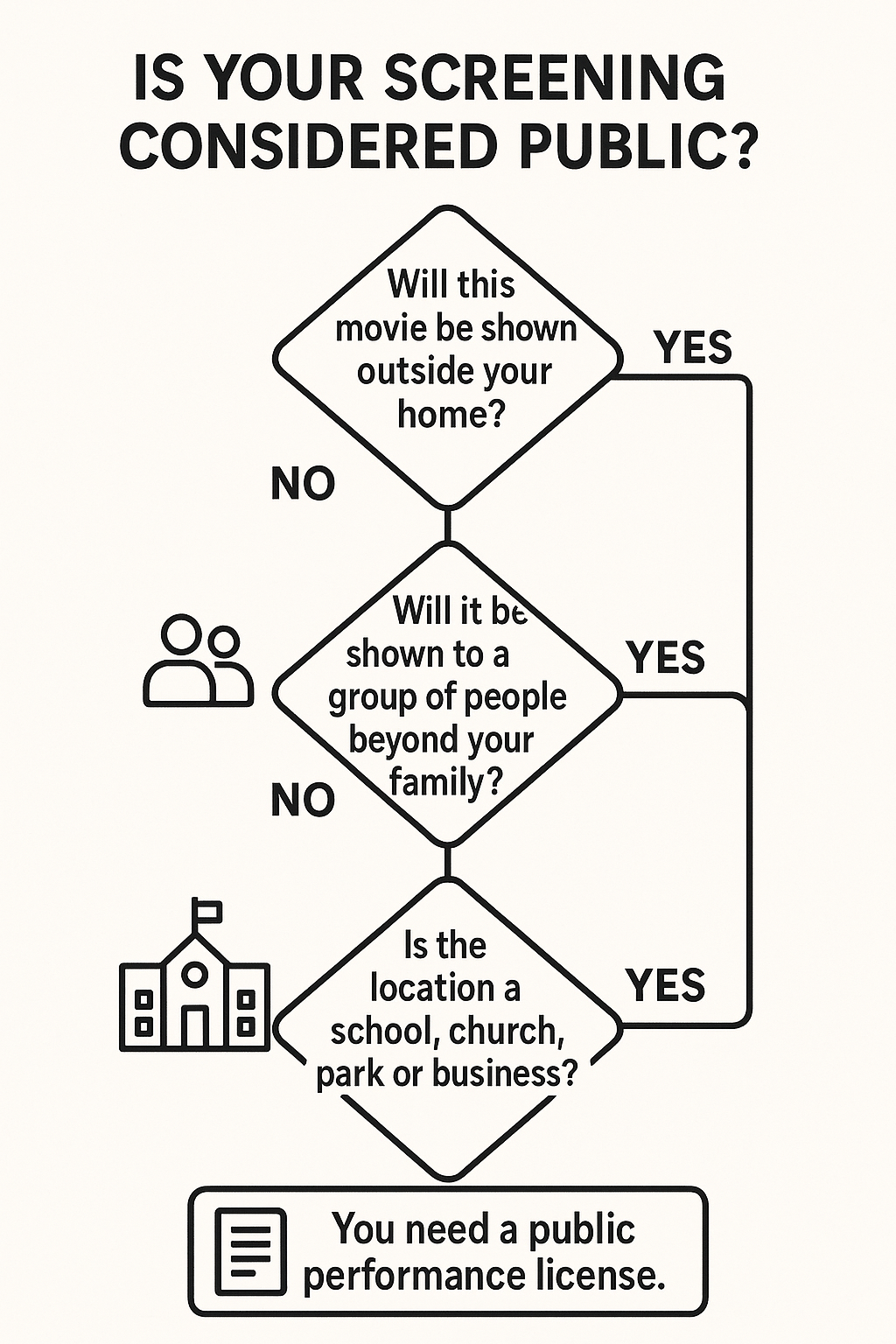
What Counts as a “Public” Screening?
Many people assume that if no money is exchanged, no license is needed. That’s a dangerous misconception.
A “public screening” is defined by U.S. copyright law as any presentation of a movie outside a private home, to a group beyond the family or close social circle. This includes:
School classrooms (even without ticket sales)
Church youth groups
University film clubs
Community events in parks, libraries, or malls
Nonprofit fundraisers—even if entry is free
Pro Tip: Even semi-private spaces like corporate offices or training centers count as public under copyright law. If it’s outside the home and not one-on-one, assume you need a license.
A screening is considered public whenever it occurs outside private home settings or includes a broader audience.
What Happens If You Skip Licensing?
Skipping a license can lead to serious consequences—even for first-time or well-intentioned violations. Here’s what you’re risking:
Copyright infringement fines of $750 to $150,000 per violation
Cease and desist letters from rights holders
Takedown notices on platforms like YouTube or Vimeo
Loss of reputation—especially for schools or community orgs
Future denial of licensing access if blacklisted
Real Example:
In 2020, a school in Illinois held a public screening of a popular animated movie during a PTO fundraiser. They used a legally purchased DVD and didn’t charge for entry. Still, the school received a formal complaint and was forced to pay a $2,500 settlement fee—plus legal costs.
Even YouTube creators have been hit with instant takedowns and monetization loss for posting content with unlicensed background footage—even when only a few seconds were used.
How Much Does a Movie License Cost?
General Price Ranges by License Type
Streaming License (VOD platforms):
$300–$1,500+ per title
Used for YouTube, Vimeo, personal sites, or OTT apps.
Public Performance License (one-time event):
$350–$1,000
For outdoor screenings, campus events, or school assemblies.
TV Show Rights / Adaptation License:
Varies greatly—often custom-negotiated
May include percentage royalties or flat licensing fees.
Umbrella License:
$600–$2,000+ annually
Allows unlimited public showings from a pre-approved catalog (e.g., for schools or churches).
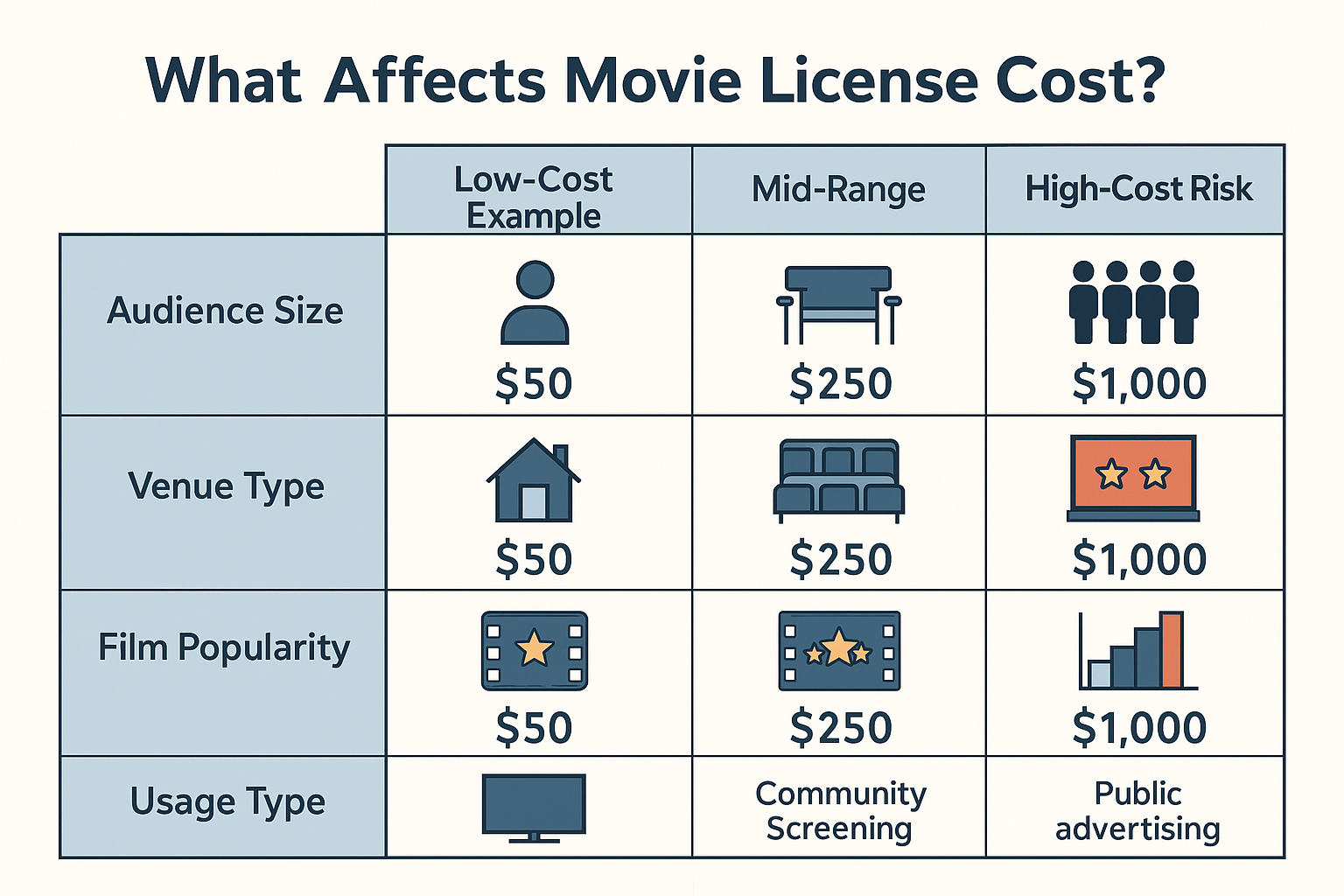
What Affects the Cost?
1. Audience Size:
• Smaller audiences (<50) generally pay less.
• Larger or commercial audiences raise costs significantly.
2. Venue Type & Location:
• Outdoor or high-capacity venues often require higher-tier licenses.
• Global usage for streaming adds regional rights fees.
3. Film Popularity:
• Licensing a Disney or Marvel title costs far more than an indie film or educational doc.
4. Distribution Format:
• Streaming, in-person, educational, or multi-platform use all affect the pricing tier.
Pro Tip: If you’re licensing multiple films at once, ask about volume discounts—some agencies offer 10–30% off for bulk deals, but you need to request it explicitly.
Licensing costs vary widely based on audience size, venue, film type, and the way the content will be used.
Case Studies
Case Study 1: YouTube Creator Licensing Archival Footage
Miguel, a documentary YouTuber, wanted to use 20 seconds of 1950s film footage in a monetized episode. He licensed the clip for $675, including limited online rights for North America. Because he detailed his audience size and platform, he avoided delays.
Case Study 2: Public School Using an Umbrella License
An elementary school in Oregon hosts monthly movie nights. Instead of paying $400–$600 per film, they secured a $895 annual umbrella license from MPLC—covering over 1,000 titles. The license paid for itself after two events.
These examples show how flexible—and variable—movie rights costs can be. Planning ahead and matching the right license to your needs is key.
Where to Get a Movie License
Licensing a movie legally starts with knowing where to go. The process isn’t always centralized, but there are trusted agencies that specialize in different types of movie rights depending on your purpose.
Trusted Licensing Agencies
Swank Motion Pictures Best for: K–12 schools, colleges, libraries, parks, and corporate eventsCatalog includes: Disney, Sony, Universal, and more Covers: One-time screenings or annual licenses Website: https://www.swank.com
Criterion Pictures USA Best for: Universities, faith-based organizations, and nonprofit groupsCatalog includes: Fox, Searchlight, MGM, and indie titles Covers: Public performance and educational use Website: https://www.criterionpicusa.com
Studios Directly (for streaming or custom digital projects) Best for: YouTube creators, OTT app founders, or film distributorsStudios like Warner Bros., Lionsgate, or indie producers require direct negotiation Use IMDb Pro, LinkedIn, or studio website contact forms
Pro Tip: When requesting a quote, include your audience size, venue or platform, titles you're interested in, and whether the project will be monetized. This reduces back-and-forth and gets you faster approvals.
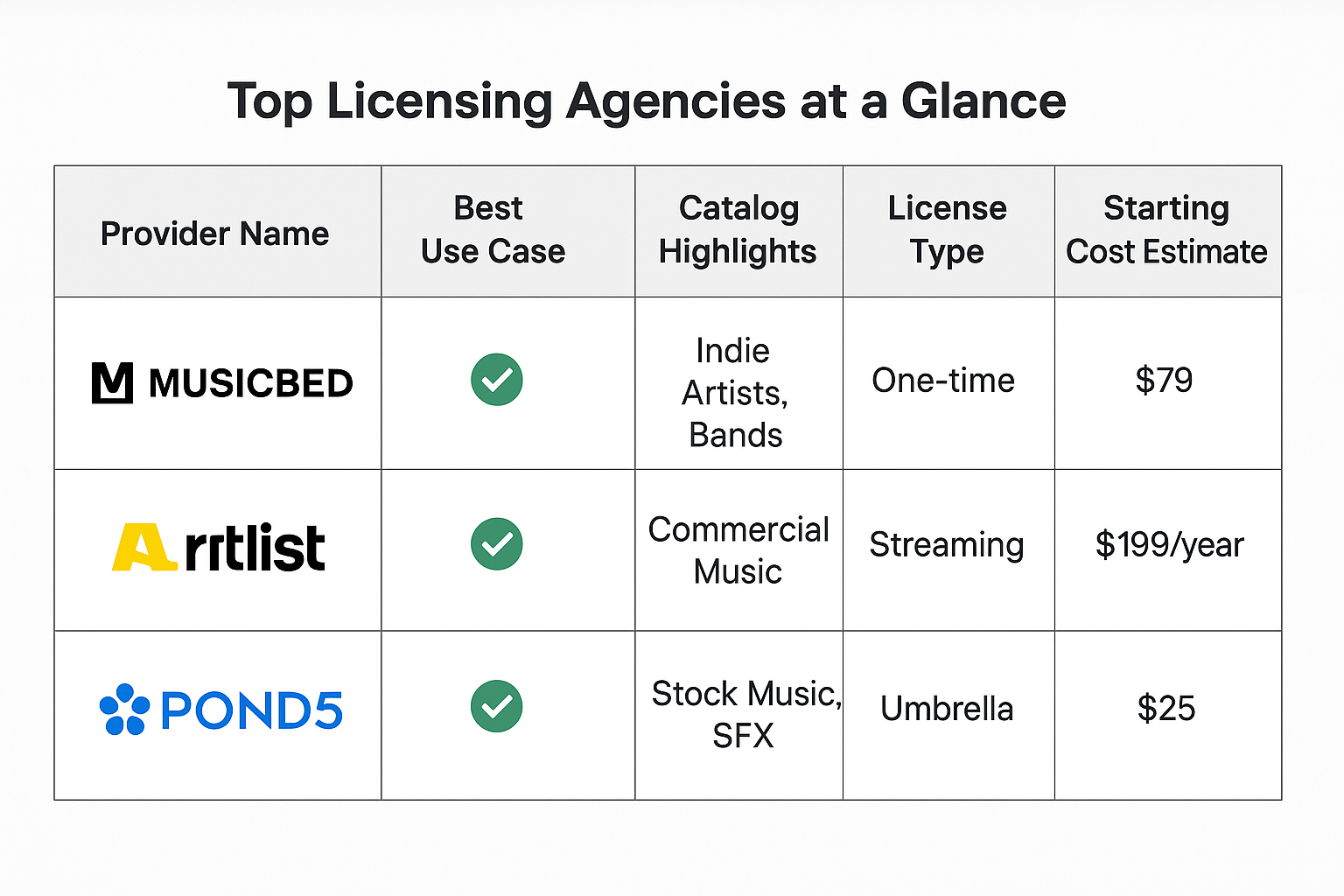
A quick comparison of major licensing agencies and their pricing for music and media rights.
How to Get a Quote or License
Getting started is simpler than it seems. Here’s how:
Visit the official website of the licensing agency.
Navigate to the licensing request form (often under “Request a Quote” or “Contact Us”).
Submit details, including:
Your organization or channel name
Location of screening or platform
Anticipated audience/viewership
Title(s) requested
One-time use vs ongoing series
Wait for a formal quote (typically arrives within 1–5 business days).
For digital/streaming licenses, prepare to:
Sign a formal agreement
Clarify distribution territories (U.S. only vs worldwide)
Provide projected traffic estimates if monetized
Stat to Know: According to MPLC, over 250,000 U.S. businesses and institutions currently hold umbrella licenses—proof that legal screenings are far more common than most people realize.
Special Considerations for Online & Streaming Use
Can I Use Clips on YouTube or Instagram?
Just because others do it doesn’t make it legal. Using copyrighted movie clips on platforms like YouTube, TikTok, or Instagram requires a license—unless your usage clearly qualifies as fair use (which is rare).
Licensing vs. Fair Use:
Licensing gives you legal permission from the rights holder.
Fair use is a legal defense, not a right, and applies only in narrow cases such as:
Commentary or critique
News reporting
Parody or transformative analysis
Non-commercial educational use
Common Misconceptions:
“It’s under 30 seconds—it’s fine.” → False. No legal safe zone exists.
“I’m not making money.” → Still requires a license.
“I gave credit.” → Credit ≠ permission.
Real Example: A fitness YouTuber uploaded a video containing a 15-second Marvel clip in the background. Her entire channel was demonetized after repeated claims—even though she earned nothing from that specific video.
Pro Tip: Some studios and agencies offer micro-licensing specifically for creators. Check platforms like Getty, Producers Library, or Studio-based clip licensing portals.
Licensing for Streaming Platforms (Netflix, Amazon, etc.)
Getting your film on Netflix or Amazon doesn’t mean they clear rights for you. As the creator, you must secure all third-party rights, including:
Archival footage
Music
Artwork
Background TV or movie clips
Indie filmmakers typically secure:
A distribution license for their original film
Clearance licenses for any third-party content
Errors & Omissions (E&O) insurance to protect against disputes
Stat to Know: Sundance reports that 89% of films submitted to streaming platforms experience delays due to missing licensing documents or uncleared materials.
Derivative Works: Adapting TV Shows, Documentaries, or Books
If you plan to:
Adapt a movie into a series
Turn a documentary into a podcast
Reinterpret a film for a modern audience
…you’re creating a derivative work—and that requires explicit written permission.
This usually involves:
Optioning the rights to the original property
Negotiating license terms and royalties
Signing contracts defining usage, length, and territorial scope
Real Example: An indie producer filmed a pilot for a series based on a 1990s cult film—without securing adaptation rights. The writer’s estate issued a takedown, and the entire project was shut down permanently.
Pro Tip: Use IMDbPro, studio legal departments, or entertainment law firms to locate rights holders. Never assume older or out-of-print titles are public domain.
🎬 Video Idea
Explainer Video: “Licensing for Digital Creators: What You Can and Can’t Do”
Walkthrough of real YouTube/TikTok examples
Side-by-side comparison of fair use vs licensing
Checklist: “Ask these 3 questions before using any movie clip”
Ideal format: 90 seconds, optimized for mobile autoplay
Umbrella Licenses: Are They Worth It?
What They Cover (And What They Don’t)
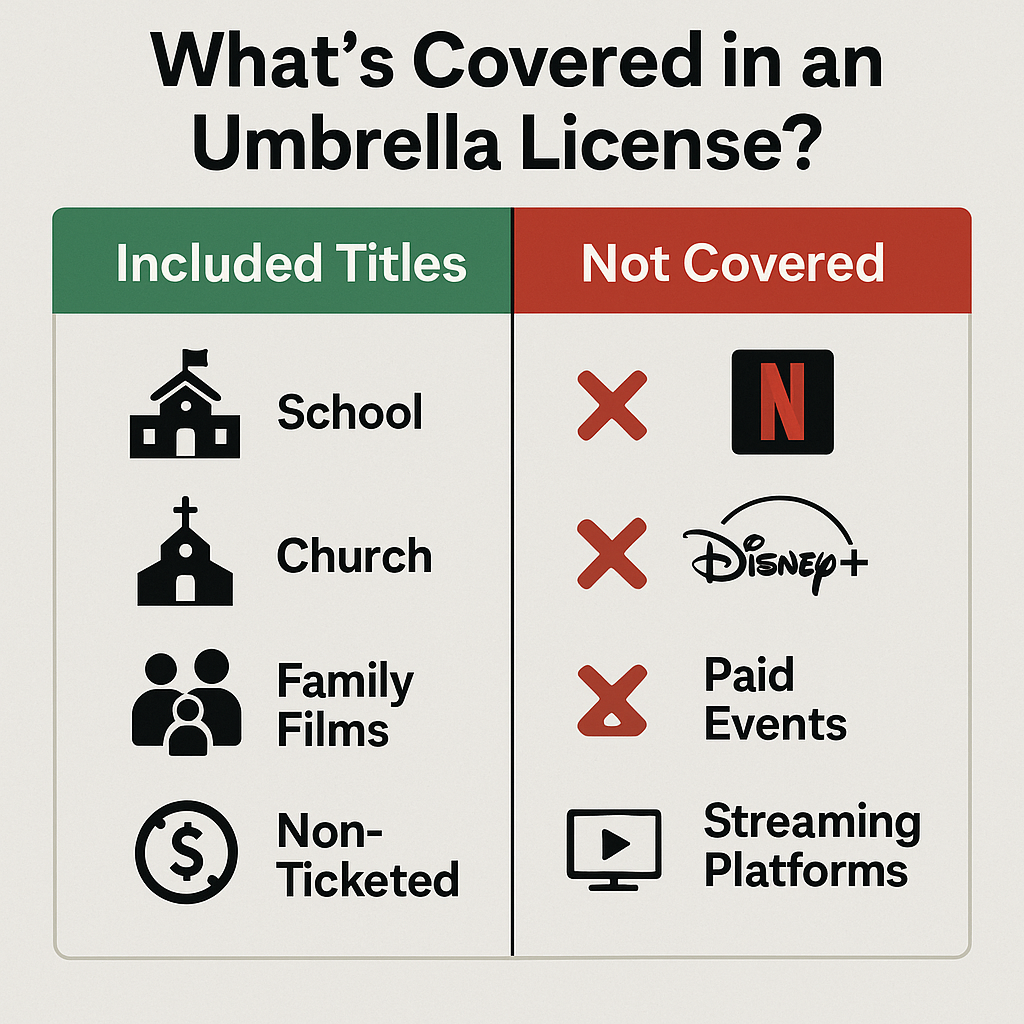
An umbrella license is a flat-rate agreement that allows organizations to show a wide variety of movies without needing to request permission for each title. It’s convenient, affordable, and ideal for recurring or institutional use.
Most umbrella licenses do cover:
Major studio content from participating distributors
Unlimited showings (as long as no admission is charged)
But they do not include:
Films outside participating catalogs (like most Disney, Marvel, and Paramount titles)
Streaming or digital distribution rights
Theatrical screenings, ticketed events, or adaptations
Pro Tip: Always review the actual title list before signing. MPLC and Swank provide searchable catalogs so you can verify whether your desired films are included. Don’t assume a title is covered just because it’s well known.
Umbrella licenses cover non-ticketed, institutional screenings but exclude major streaming platforms and paid events.
When It Makes Sense to Get One
An umbrella license is usually the most cost-effective option if you:
Host frequent screenings throughout the year
Operate in a public or semi-public venue (e.g., churches, campuses, rec centers)
Need a hassle-free solution with no per-title negotiation
Don’t need access to blockbusters or theatrical releases
Real Example: A public library in Florida screens one family-friendly movie per week. Rather than pay $350+ per title, they secured an annual umbrella license from MPLC for $875. With over 50 screenings per year, their cost per film dropped to less than $18.
According to MPLC, over 250,000 organizations in the U.S. hold umbrella licenses—including 70% of public universities. If your use case fits this model, the convenience and savings can far outweigh the limitations.
Public Domain and Royalty-Free Alternatives
What Is Public Domain?
Movies in the public domain are no longer protected by copyright, meaning they can be used, screened, copied, and even modified without needing to license or pay royalties. This makes them a goldmine for educators, indie creators, and nonprofits with limited budgets.
A film typically enters the public domain if:
Its copyright has expired (usually 95 years after publication for works before 1978)
It was never properly registered or renewed
It was released under a public domain dedication
How to check if a movie is public domain:
Search the U.S. Copyright Office database
Look it up on trusted public domain catalogs (see below)
Avoid relying on YouTube comments or torrent sites
Pro Tip: Just because a film is “old” or freely available online doesn’t mean it’s public domain. Always verify through reputable legal or archival sources.
PublicDomainMovies.net – Clear labeling of public domain titles
The Library of Congress – Cultural and historical films
OpenFlix – Casual screenings and mashups
Folkstreams.net – Independent and ethnographic films
Kanopy – Some titles free with library cards
Creative Commons Search – Filterable by reuse license
Europeana.eu – Vintage films from European archives
Vimeo’s Creative Commons – Indie films released for reuse
Real Example: A community college film studies professor built an entire semester curriculum using only public domain films. With zero licensing budget, she used Archive.org to stream classics like Night of the Living Dead and His Girl Friday—legally, and for free.
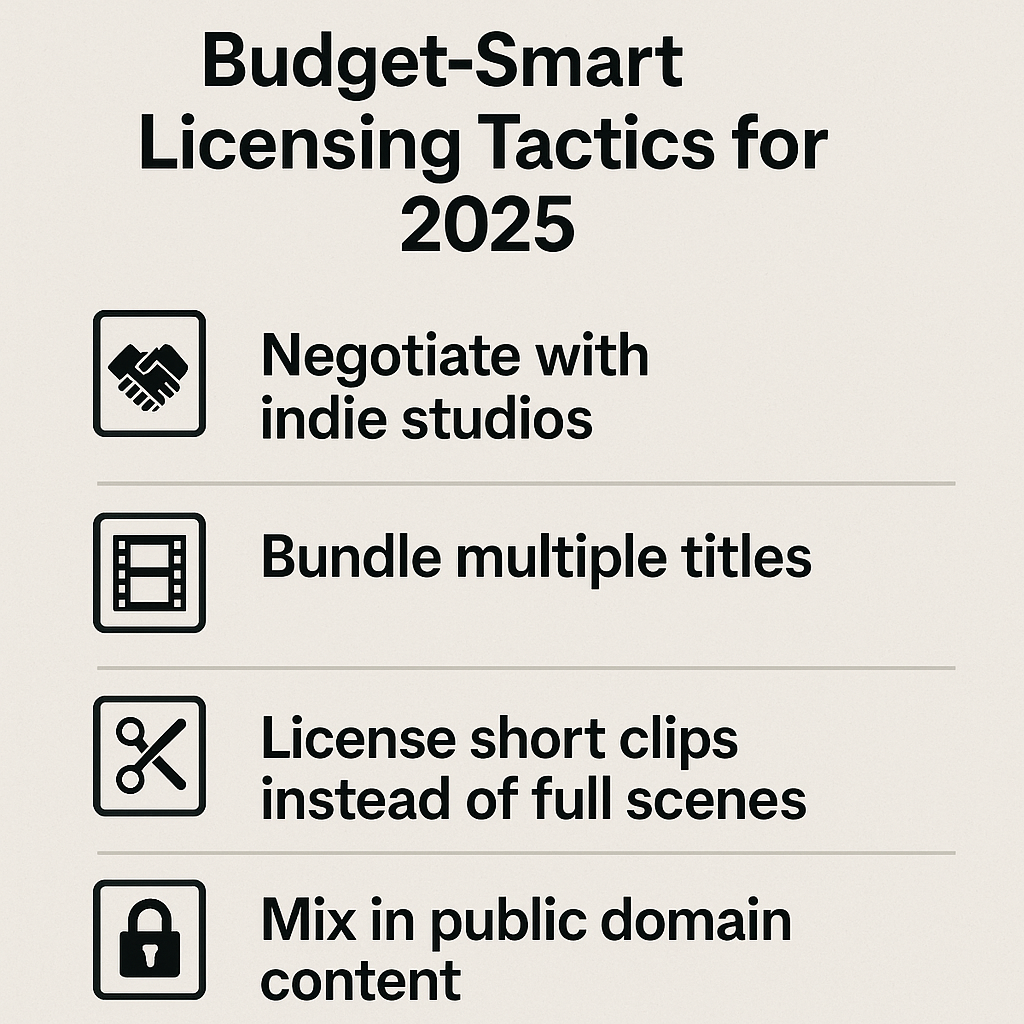
Smart strategies for reducing movie licensing costs without compromising quality or compliance.
Mix Licensed + Public Domain Content
You don’t need a blockbuster lineup to create great content. Mixing in public domain or royalty-free films with one or two premium licenses can stretch your budget significantly.
Real Example: Educators often pair a licensed documentary with free public domain newsreels to build full lessons with half the cost.
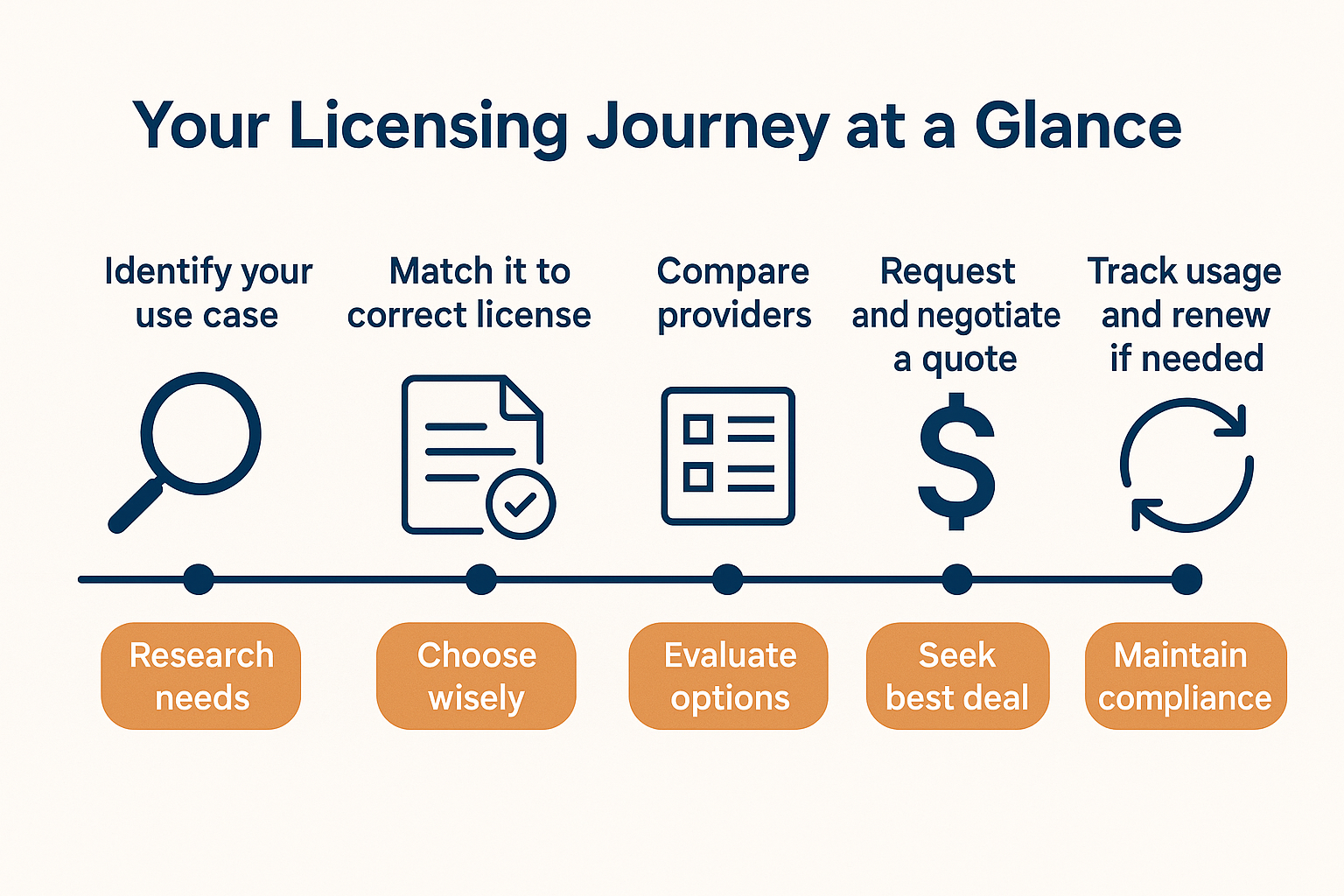
Your full licensing roadmap—from identifying your needs to maintaining long-term compliance.
Conclusion: Licensing with Confidence
If you've made it this far, you're already ahead of most content creators, educators, and event organizers. Understanding the movie rights cost and licensing process is no longer optional—it’s a core part of running a compliant, sustainable media project.
Key Takeaways:
Licensing is required for any public screening or digital use—even if it's free.
Costs vary: from $300 for a simple event license to over $2,000 for annual or streaming use.
Umbrella licenses are ideal for schools, churches, and libraries that host recurring screenings.
Streaming and online creators need to be especially careful—platforms like YouTube and Amazon can issue takedowns quickly.
Real Story: When Sarah launched her independent streaming site, she budgeted $10,000 for platform development—but only $300 for licensing. Three months in, she received three copyright complaints and had to pull down half her catalog. After consulting with a licensing agent, she restructured her model using short-form clips and royalty-free titles. Now her platform is thriving—with zero flags since.
Pro Tip: Set up a simple spreadsheet to track licensed content. Include license type, expiration date, provider, and usage rights. This will save you hours—and legal stress—later.
Take the Next Step Toward Smart, Legal Licensing
Now that you understand how licensing works, what it costs, and where to get it, the next move is simple: don’t guess—calculate. Whether you're planning a film screening, launching a streaming channel, or teaching with media, the right license can make or break your project’s legality.
Real Example: James, a university film club president, used our free licensing calculator before organizing a semester-long screening series. Instead of paying $600 per film, he discovered that a $1,150 umbrella license covered 90% of his lineup. That insight saved his program nearly $4,000.
Frequently Asked Questions (FAQ)
How much does it cost to show a movie publicly?
Typically $350–$1,000 per screening depending on the title, audience size, and venue.
Example: A school screening a PG-rated film for 150 attendees would likely pay around $500.
Pro Tip: For regular screenings, a flat-rate umbrella license may cost less long-term.
What’s the difference between an umbrella license and a one-time license?
An umbrella license covers unlimited showings from a specific catalog; a one-time license covers a single event.
Stat to Know: Organizations screening more than 4 films per year usually save with umbrella licenses.
Can I stream a movie on YouTube if I bought a DVD?
No. DVD ownership does not equal streaming rights. A separate license is needed.
Example: A creator uploaded a Disney DVD to YouTube and received a copyright strike within 24 hours.
Pro Tip: Always secure digital distribution rights, even for non-commercial or fun content.
Where do I buy the rights to a TV show or movie for streaming?
Purchase from agencies (e.g., Swank, Criterion), studios (via IMDbPro or direct), or rights platforms like Producers Library.
Specify usage: YouTube, app, internal
Include audience size and monetization status
Mention distribution regions and duration
Pro Tip: Request short-term licenses (e.g., 30–90 days) to reduce costs if available.
Do I need a license for a free outdoor screening?
Yes. Even if you’re not charging admission, a free outdoor screening is still considered a public performance under U.S. copyright law.
Whether it’s on a school field, in a park, or in your neighborhood, you’ll need a public performance license.
Real Example: A community organization in Texas hosted a free Pixar film night in a local park without a license. They received a $2,800 penalty three weeks later.
Pro Tip: Outdoor events tend to attract larger audiences—always factor that into your license request for accurate pricing.